

AI-powered CRM software for sales teams, from lead to revenue
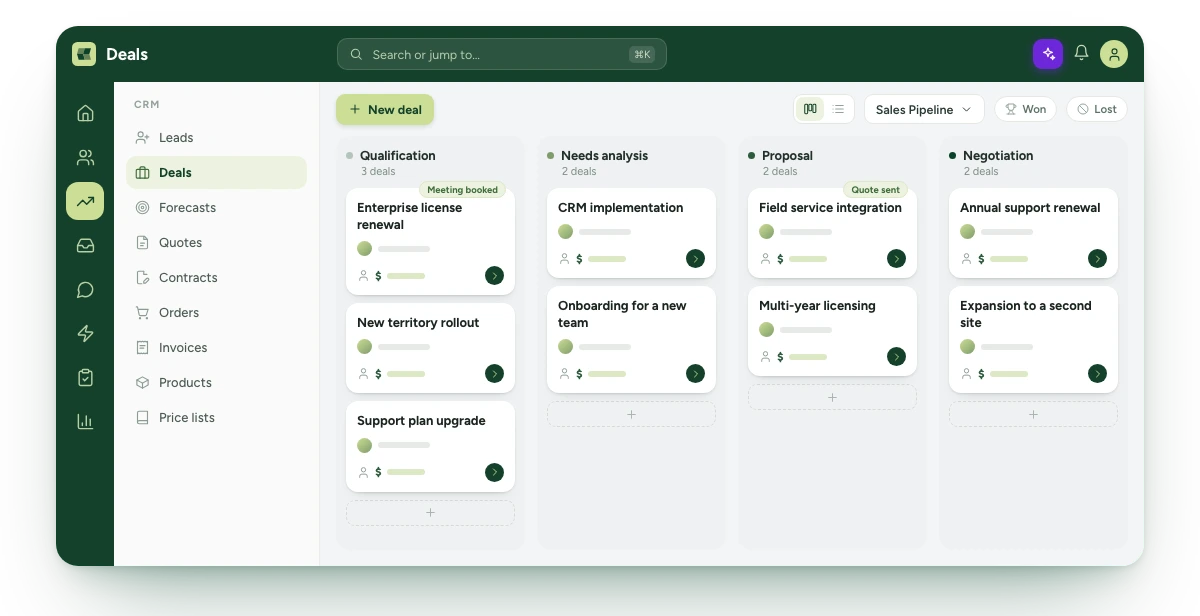
Senitix CRM is AI-powered CRM software for sales teams: leads, contacts, accounts, deals, activities and reports on one shared customer record. Quotes, Gmail and Outlook sync, automation, forecasting and Senitix AI work on that same record, and a won deal continues into a contract, an order and an invoice.
Short answer
CRM software keeps every lead, deal, quote and customer conversation in one shared record, so reps, managers and finance read the same numbers instead of reconciling separate spreadsheets and inboxes. Each customer then has one history, one owner and one agreed next step. See what a CRM is and how it works.
What does Senitix CRM include?
Four areas of one product, all on one customer record. Each card describes what works today, and the pricing page compares what each plan includes.
One timeline the whole team can read
Calls, meetings, notes, files, email threads, quote versions and the person responsible all sit on the deal itself. Nobody has to ask where something stood, or wait for the one person who knows.
- Activity, files and correspondence on the record rather than in someone's inbox
- Each record's field history shows who changed what, and when
- An owner on every record, so everyone knows who takes the next step
The people who touch a deal, and what each of them may see
Sales, operations and whoever signs the contract work the same record. Role and field permissions decide which records and fields each of them can open, so a shared record does not become an unrestricted one.
- Roles, departments and ownership set who reaches which record
- Field permissions keep cost, margin and other sensitive values to the roles that need them
- An audit trail records who changed which setting, and when
From the price book to the invoice
A quote is built from products and price books and keeps its own versions. Once the customer accepts it, it hands off to a contract, an order and an invoice without anyone retyping the line items.
- Quote versions kept on the deal, so the revision on file is the one the customer holds
- Discounts routed to named approvers before the quote moves on
- Contracts, orders and invoices continue from the won deal
See the deal drift before your customer does
Reports read the same records the team works in, and a report chart opens down to the deals behind each bar or slice. An automation rule can raise the follow-up before anyone notices the silence.
- Deals with no next activity, and quotes still open past their expiration date
- Aging by stage, loss reasons, cycle time and team performance
- A rule that opens a dated task with a named owner
Senitix AI
AI that prepares the decision
Senitix AI works only from records the user can already open. It prepares the work; a person reviews, edits, accepts or discards every suggestion, and nothing is sent or changed until someone confirms it.
- A daily digest of open work, and copilot answers drawn from the records you can see
- Email drafts, rewrites and thread summaries, edited by a person before anything is sent
- A suggested next action, which becomes a task only when someone accepts it
- A daily request allowance for each user, so one heavy user cannot use up everyone else's requests
Who is Senitix CRM for?
Sales teams that sell to businesses or to consumers, from a founder and a first rep to a sales organization with several teams and managers. Reps, managers and finance work on the same customer record, and each of them sees what their role needs.
Reps
Every customer and follow-up on one record
Leads, contacts, accounts and deals share one timeline of calls, meetings, notes and the threads from a connected Gmail, Outlook or IMAP mailbox, and every open deal can carry a dated next step with a reminder.
Start freeSales managers
A pipeline the whole team reads the same way
Each pipeline runs on the team's own stages, the forecast sets open deals against each rep's quota, and reports and dashboards read the records reps work in. Automation rules create the follow-up tasks nobody should have to remember.
See every capabilityOperations and finance
From the accepted quote to the invoice
Quotes are built from price books and kept as numbered versions, discounts go to named approvers, and a won deal continues into a contract, an order and an invoice. Role and field permissions keep cost and margin to the people who need them.
Talk to salesAn example setup for your industry
Each industry page shows an example setup: the pipeline stages, the fields a deal carries and the quote steps a team in that industry can configure. It is a starting point to adapt, not a template applied to your workspace.
-
Wholesale Distribution
Parent accounts for customer locations, a price book per channel, approved special pricing and a dated follow-up before each expected reorder.
-
Manufacturing
RFQs, drawing revisions, sample results, versioned quotes with valid-until dates, discount approvals and the handoff to production on one deal.
-
Professional Services
Referral sources, fee proposal versions, signed engagements, delivery handoffs and renewals on one deal.
-
Legal Services
Intake, the conflicts check, consultations, fee proposals and referral sources on one record, apart from the matter file.
-
Engineering & Architecture
Go/no-go decisions, selection committees, discipline scope, fee proposal versions and the kickoff handoff on one deal.
-
Logistics & Transportation
Spot RFQs, quote versions, bid-season awards and contract renewals on the shipper record, for brokers, carriers, 3PLs and forwarders.
-
Construction & Real Estate
Invitations to bid, the go/no-go, estimate revisions, owner relationships and the award handoff on one deal.
Companies already running on Senitix CRM
What each team set up, and how its sales work changed. Every page cites the company's own public facts.


Learn the category before you shortlist
Long-form guides for the person who has to make the decision: how to choose, run and govern a CRM.

Free CRM: how far a free plan gets you
How to tell a forever-free plan, a trial and open source apart, what a free plan costs you in work, which export you actually get, and when to move off it.

The benefits of a CRM, and how to measure them
Eleven benefits of CRM, each with a named measure (the numerator and denominator in plain words) so you can prove the change instead of claiming it.

The CRM features that matter, and the job each one does
The 19 CRM features that matter, each explained as the job it does (records, pipeline, quotes, email, automation, reporting) and which to set up first.

CRM examples: how teams actually use one
Five illustrative CRM workflows: lead to deal, quote to invoice, renewal, dealer orders and applicant intake, with the records each needs and the tool to test.

Choosing the best CRM for the team you have
Four decisions, five trial tests and the questions every vendor should answer, plus Senitix, Salesforce, HubSpot, Zoho and Pipedrive side by side.

CRM implementation, from decision to go-live
CRM implementation in nine steps, from needs assessment to the review after go-live: who runs each step and what must be true before the next one starts.
Questions people ask before deciding
Which plan includes which features?
Every plan, Free included, covers leads, contacts, accounts, deals, activities, a product catalog, reports and dashboards. Growth adds quotes, Gmail and Outlook sync, automations, custom fields and Senitix AI. Professional adds contracts, orders, invoices, approvals, forecasting, rule-based scoring and custom objects. Enterprise adds single sign-on through OpenID Connect and the highest limits. The pricing page lists every limit and what is still coming soon.
How much does Senitix CRM cost?
The Free plan costs nothing for up to 2 users, with no time limit and no credit card. Growth, Professional and Enterprise are priced per user per month in U.S. dollars, and yearly billing, charged upfront, saves up to 39%. Enterprise has a seat minimum. Paid plans have no free trial, so Free is the way to try the product; the pricing page lists every price and limit.
Is Senitix CRM right for a small team?
Yes, if the team sells through a pipeline and quotes, to businesses or to consumers. Leads, contacts, accounts, deals, activities and reports sit on one shared record from the first user, and quotes, email sync and automation work on the same records, so nothing is migrated as the team grows. Senitix CRM runs in a web browser; native mobile apps are not available yet.
Does Senitix CRM work with Gmail and Outlook?
Yes. Each rep can connect a Gmail, Microsoft Outlook or other IMAP and SMTP mailbox, and each thread lands on the contact, account or deal it belongs to. Google Calendar and Microsoft Calendar sync as well. There is no Slack or Zapier connector; other integrations run through apps Senitix registers, so ask us about yours. WhatsApp and other messaging channels, Zoom and Google Meet links, and outgoing webhooks are coming soon.
What does Senitix AI actually do?
Senitix AI writes a daily digest, answers questions from the records a user can already open, drafts and rewrites email, summarizes threads and suggests a next action. A person reviews every output, and nothing is sent or changed until someone confirms it. Each user has a daily request limit. Lead and deal scoring is a separate, rule-based capability, not AI.
Does it handle quotes and invoices, or only the pipeline?
Both. Quotes are built from your product catalog and price books, kept as numbered versions and sent as a PDF from your own template. An accepted quote continues into a contract, an order and an invoice with its line items carried over, and payments are recorded against the invoice. Signatures are collected outside Senitix, and there is no QuickBooks or Xero connector.
Can two teams run different sales processes?
Yes. Each pipeline has its own stages, so a new-business team and a renewals team do not have to share one shape, and how many pipelines a workspace can run depends on its plan. Each stage can show guidance text and up to five key fields, so reps see what the team agreed must be true before a deal moves on. The product shows them; it does not block the move.
Can I import my data, and take it with me if I leave?
Yes, on every plan. Leads, contacts, accounts, deals and other records import from CSV or Excel files and export in the same formats, and a full data export can be scheduled. There is no one-click connector from Salesforce or HubSpot, so moving from another CRM is a file import: settle the field mapping and how duplicates will be handled before it runs.
What does CRM software actually do, in plain terms?
In plain terms, a CRM keeps every lead, contact, deal, conversation and document a team is working on in one shared record, so anyone who needs to know what is happening with a customer can check the record instead of asking around. Deals move through stages, activities get logged as they happen, and reports read straight from what is actually in the pipeline rather than from a spreadsheet someone updates by hand.
Is Senitix CRM cloud-based or on-premise?
Cloud-based. Senitix CRM runs in a web browser, with no software to install and no server for your team to maintain; there is no on-premise version and no native mobile app yet. For where the data itself is hosted, see security and hosting.